
Establishing a powerful AI music creative direction is the single most critical factor in modern generative audio production. To the casual listener, generative artificial intelligence feels like an automated shortcut. Many creators assume that they can simply enter a basic prompt, click a button, and receive a finished masterpiece. However, this hands-off approach yields highly predictable, generic, and flat musical compositions.
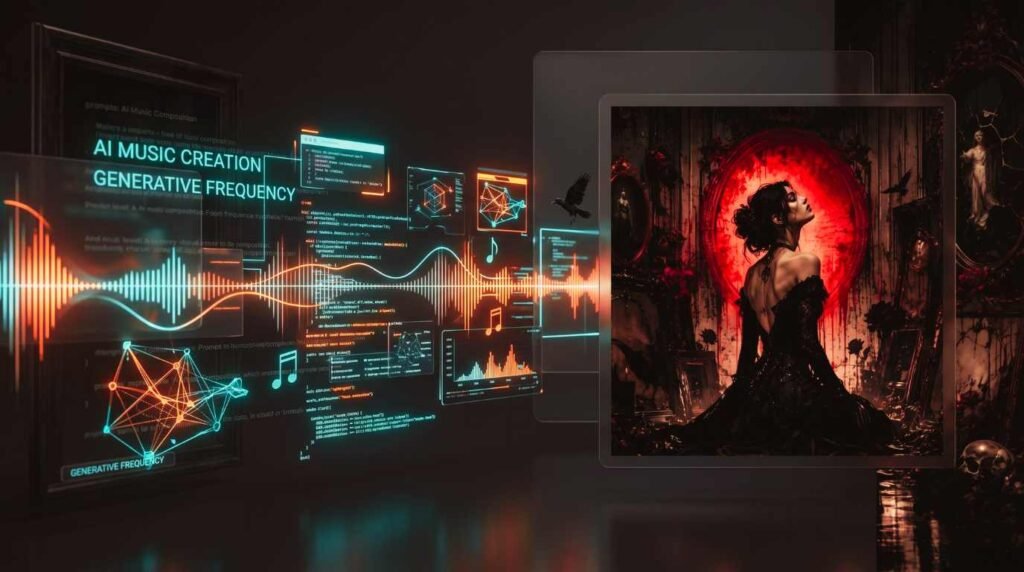
If you want to create deeply moving, cinematic soundscapes, you must move beyond simple automation. Consequently, professional music production requires you to step into the role of an active director. This comprehensive case study explores our experimental concept album, The Art Of Love. Throughout this project, we bypassed the “magic button” trap by implementing rigorous AI music creative direction to orchestrate highly complex neural audio models.
By treating generative models as a sensitive orchestra rather than a vending machine, we established an innovative workflow. This guide breaks down the technical frameworks, prompt design philosophies, and modular pipelines that define high-level AI music creative direction.
The Evolution of AI Music Creative Direction
Historically, music production underwent dramatic shifts with the introduction of synthesizers, samplers, and digital audio workstations (DAWs). Specifically, each technological leap initially faced skepticism before artists learned to control the new mediums. Today, generative audio models represent a similar frontier. Without professional AI music creative direction, these deep neural networks rely heavily on statistical averages. As a result, they generate safe, radio-friendly structures that completely lack emotional risk.
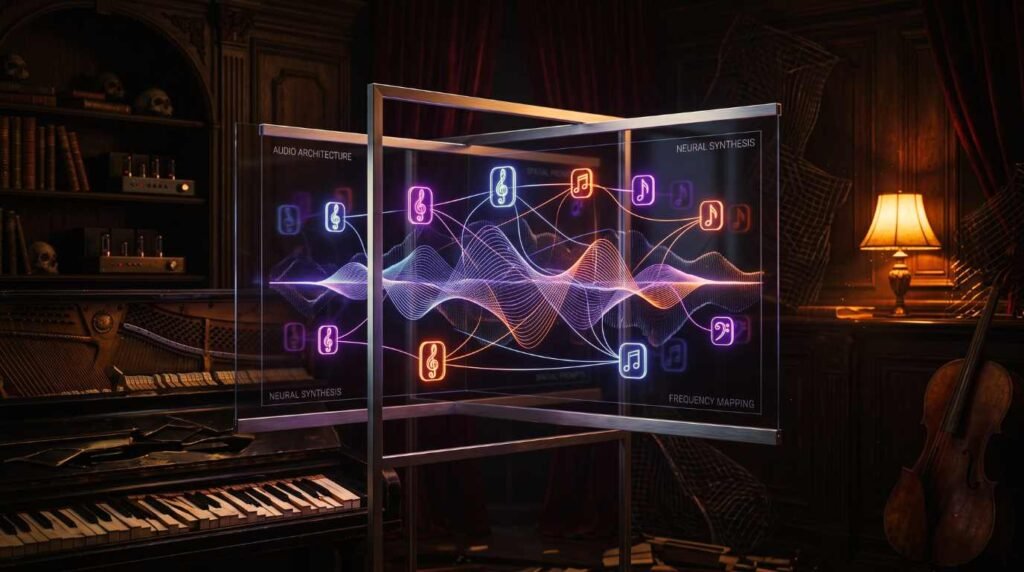
Therefore, the modern producer must act as an intellectual architect. In this new paradigm, your primary instrument is no longer a physical keyboard or a mixing console. Instead, your primary tool is conceptual clarity. Through precise AI music creative direction, you translate abstract human feelings into structured instructions that neural networks can interpret.
This process does not replace the artist. On the contrary, it demands a more profound understanding of music theory, acoustic space, and emotional psychology than traditional tracking requires.
The Conceptual Architecture of The Art of Love
We did not build our album, The Art Of Love, by asking an algorithm to “generate a dark romantic soundtrack.” Instead, we constructed a strict thematic envelope. We wanted to explore the thin boundary between beauty and psychological obsession. Consequently, every generation required a unified thematic anchor.
To visualize this workflow, we can look at the conceptual pipeline of our AI music creative direction:
+-----------------------------------------------------------------+
|                       HUMAN CREATIVE INTENT                     |
|            Deep thematic concept & emotional blueprint         |
+-----------------------------------------------------------------+
                                 |
                                 v
+-----------------------------------------------------------------+
|                   AI MUSIC CREATIVE DIRECTION                   |
|         Translating concepts into structured directions         |
+-----------------------------------------------------------------+
                                 |
        +------------------------+------------------------+
        |                                                 |
        v                                                 v
+--------------------------------+               +--------------------------------+
|       MODULAR PROMPTING        |               |      BEHAVIORAL MAPPING        |
|  Decoupling vocals & acoustics |               |   Directing emotional sonics   |
+--------------------------------+               +--------------------------------+
        |                                                 |
        +------------------------+------------------------+
                                 |
                                 v
+-----------------------------------------------------------------+
|                      NEURAL AUDIO ENGINES                       |
|          Suno AI / Udio AI generative waveform synthesis        |
+-----------------------------------------------------------------+
                                 |
                                 v
+-----------------------------------------------------------------+
|                     DYNAMIC SONIC RESULTS                      |
|         Highly intentional, cinematic, and emotional tracks     |
+-----------------------------------------------------------------+
Furthermore, we made sure that every composition within the album maintained a distinct narrative goal. For example, during the pre-production phase of A Touch That Stayed, we outlined a specific dramatic scenario. We wanted the instruments to mimic the feeling of a fading memory.
To achieve this, our AI music creative direction avoided standard genre markers entirely. Instead, we directed the system to generate sparse, evaporating acoustic decay. By doing so, we ensured that the technology served the narrative, rather than letting the technology dictate the song’s structure.
Why Traditional Prompts Fail AI Music Creative Direction
To understand why traditional prompting fails, we must examine how modern neural models process input. Most public systems train on massive datasets of tagged MP3 files. Consequently, when you use generic terms like “epic,” “emotional,” or “dark,” the AI references the most common denominators in its training set. This results in standard, highly compressed commercial pop formulas.
To bypass these limitations, advanced AI music creative direction replaces simple descriptive tags with structured behavioral commands. Consider the following comparison:
| Traditional Prompting Style (Ineffective) | Advanced AI Music Creative Direction Prompting |
|---|---|
| “A sad gothic love song with piano and violin.” | “Minimalist piano chords with asymmetric timing. Violin bowing represents physical weeping, slow tempo, high-tension rests.” |
| “Industrial synth pop song with female vocals.” | “Low-frequency sub-bass sweeps. Vocal performance relies on restrained breathing, close-mic proximity, whispered transients.” |
| “Epic cinematic orchestral track.” | “Gradual crescendo. Brass instruments mimic psychological dread. Exclude standard commercial cinematic drum loops.” |
As this table illustrates, professional direction focuses on how the elements must interact, rather than merely listing what those elements are. By controlling these subtle acoustic relationships, your AI music creative direction forces the neural networks to generate highly customized and unusual waveforms.
The Modular Workflow Blueprint
If you attempt to write a single prompt that contains lyrics, instrument styles, vocal tone, and mixing instructions, you will confuse the model. Specifically, generative audio systems struggle to balance multiple complex commands simultaneously. Therefore, we developed a modular pipeline that treats different elements as separate, isolated modules.
       [ MODULE 1: LYRICAL THEME & CADENCE ]
                         |
                         v
       [ MODULE 2: VOCAL BEHAVIOR & TIMBRE ]
                         |
                         v
       [ MODULE 3: INSTRUMENTAL ENVIRONMENT ]
                         |
                         v
       [ MODULE 4: ATMOSPHERIC & ROOM ACOUSTICS ]
By separating these systems, our AI music creative direction allowed us to adjust individual variables without destroying the entire song. For instance, in Between The Lines, we finalized the instrumental environment before we introduced the vocal layer. This modular control kept our production values incredibly consistent across the entire album.
Furthermore, this separation of creative layers mirrors the traditional multi-track recording process. By importing our generative prompts in structured phases, we achieved a level of sonic polish that single-prompt generations can never match.
Prompt Engineering for Emotional Behavior
A major breakthrough during our production process involved the translation of psychological states into acoustic parameters. Specifically, we discovered that neural networks respond beautifully to metaphors of physical force and emotional tension. When we directed a synthesizer to “generate psychological pressure,” the system did not simply play louder. Instead, it altered the harmonic density of the mid-range frequencies, mimicking real human tension.
Additionally, we focused heavily on directing the behavior of individual instruments. Rather than treating a guitar as a generic chord-playing tool, we gave it a specific narrative role. In the track If You Only Knew, we instructed the guitar to “represent emotional destruction.”
Consequently, the engine produced raw, unstable transients and unexpected overtones. This proved that successful AI music creative direction relies on treating virtual instruments as living, breathing characters within a larger acoustic play.
To illustrate this behavioral approach, we map out the emotional spectrum of our direction framework below:
HIGH TENSION
   ^
   |     * [Voices Under My Skin]
   |       (Industrial sub-bass, psychological dread, cold transients)
   |
   |                                * [What Remains of Me]
   |                                  (Raw industrial clatter, severe distortion)
   |
   |     * [Still Living in You]
   |       (Evaporating synth layers, sharp transients)
   |
   |                                * [The Night We Held]
   |                                  (Slow emotional collapse, weeping keys)
   |     * [Between The Lines]
   |       (Restrained delay, close whispered vocals)
   |
   +--------------------------------------------------------------------> LOW TENSION
   |
   v
LOW TENSION
Vocal Direction and Acoustic Realism Techniques
Generating believable vocals remains one of the most difficult challenges in AI audio production. This is because the human ear is incredibly sensitive to synthetic vocal artifacts. To overcome this, our AI music creative direction avoided terms that would trigger a flawless, robotic performance. We did not request “perfect vocals” or “cinematic belts.”
Instead, we used highly specific, humanizing constraints:
- Restrained Intimacy: We directed the vocal models to use half-spoken delivery and close-mic proximity.
- Controlled Transients: We forced the model to prioritize whispering, which naturally introduces organic air and breath into the waveform.
- Acoustic Friction: We requested audible breathing, sighs, and intentional pauses between phrases.
For example, in The Night We Held, these settings forced the model to generate a raw, haunting vocal performance that feels remarkably intimate.
Additionally, we added low-density atmospheric layers like analog tape noise and room tone. By doing so, we masked digital compression artifacts and gave the master tracks an organic, analog warmth.
Case Study: Analyzing the Sonics of the Album
The true power of systematic AI music creative direction becomes undeniable when analyzing the specific tracks of The Art Of Love.
A Touch That Stayed
In A Touch That Stayed, we wanted to capture the feeling of physical distance. Consequently, our AI music creative direction dictated that the piano chords must have wide stereo panning. Furthermore, we instructed the reverb tail to bleed into the sub-bass frequencies. This created an expansive, empty space that perfectly complemented the whispered, close-up vocals.
Still Living in You
In contrast, Still Living in You required a highly rhythmic, driving foundation. However, to keep the track from sounding like a generic club loop, we introduced rhythmic instability. We instructed the percussion model to “generate erratic, ticking clock patterns.” As a result, the track maintains an uneasy, anxious momentum that drives the lyricism forward.
What Remains of Me
The final emotional peak of the album occurs in What Remains of Me. This track represents a total sonic collapse. Therefore, we used highly destructive prompt parameters. We pushed the model to its absolute limits by introducing commands for “clashing frequencies, industrial clatter, and terminal decay.” This chaotic finish stands as a testament to how bold AI music creative direction can push neural networks far beyond safe, commercial boundaries.
Advanced Prompt Architecture Templates
To help you implement this level of control in your own productions, we have outlined the structured prompt templates that we utilized during the creation of The Art Of Love. These templates demonstrate how advanced AI music creative direction organizes instructions logically.
Template 1: Atmospheric Vocal Blueprint
[Vocal Style: whispered female spoken-word, close-mic proximity, restrained emotional delivery]
[Acoustic Space: hyper-realistic room tone, vintage tape noise, long-tail cathedral reverb]
[Cadence: irregular phrasing, natural pauses, audible breathing transients]
[Exclude: pop vocal tuning, multi-layered harmonies, bright vocal EQ]
Template 2: Instrumental Tension Builder
[Instrumentation: solo minimalist upright piano, hollow room tone, warm cello swells]
[Behavior: asymmetric timing, notes representing emotional hesitation, gradual dynamic expansion]
[Transients: highly textured string friction, damp piano dampers, low-frequency sub-bass hum]
[Exclude: fast tempos, bright electronic leads, compressed pop drum patterns]
Template 3: Industrial Rhythmic Collapse
[Percussion: asymmetric industrial clatter, physical metal impacts, irregular tempo drops]
[Acoustics: distorted distortion, wet analog delay, highly metallic decay]
[Modulation: filter sweeps mimicking psychological claustrophobia, rising mid-range pressure]
[Exclude: standard 4/4 EDM kick drums, clean high-hat loops]
By utilizing these templates, you can construct a highly consistent, dark, and rich conceptual world. Furthermore, these blueprints ensure that your AI music creative direction remains in absolute control of the neural engine’s random generations.
Frequently Asked Questions
What is AI music creative direction?
It is the process of guiding generative artificial intelligence models using highly specific, emotional, and structural prompts. Rather than letting the system make the decisions, the human director controls the instruments, acoustics, and emotional behavior of the track.
Does generative AI reuse copyrighted music samples?
No, advanced generative models do not copy and paste existing MP3 files. Instead, they synthesize entirely new waveforms based on the mathematical patterns they learned during their training phases.
Why does traditional prompting produce generic music?
Traditional prompts rely on simple genre tags and commercial keywords. Consequently, the AI references the most common denominators in its training data, resulting in highly formulaic, repetitive music.
How do you achieve vocal realism in AI music?
By prompting for human errors and physical behaviors. Instructing the model to include audible breathing, whispers, close-mic proximity, and tape hiss masks digital artifacts and creates a realistic performance.
Can you control the exact structure of an AI song?
Yes, by using structured arrangement timelines and modular workflows. By separating your instrumental generations from your vocal generations, you can sculpt the dynamic progression of the track with extreme precision.
Conclusion
The production of The Art Of Love demonstrates that artificial intelligence is not a threat to human artistry. On the contrary, it is a mirror that reflects the depth of your own artistic vision. Without deliberate AI music creative direction, these powerful neural networks can only generate flat, commercial background music.
However, by establishing strict conceptual boundaries, implementing a modular workflow, and directing emotional behaviors, we transformed raw machine learning into a deeply personal, cohesive, and hauntingly beautiful album. Ultimately, the future of music does not belong to automation. It belongs to those who know how to direct it.