
The global landscape of AI music production is undergoing its most profound transformation since the invention of the digital audio workstation (DAW) and the synthesizer. For decades, creating radio-ready or cinematic-grade music required thousands of dollars in high-end hardware, pristine acoustic environments, and years of highly specialized technical training. Today, a new creative paradigm is emerging—one where human emotion and artistic direction closely partner with artificial intelligence to reshape how sound is conceived, structured, and delivered.
This is not about replacing the human soul; it is about amplifying it. Welcome to the era of AI Music Production. Whether you are an independent filmmaker looking for an evocative score, a content creator in need of unique background soundscapes, or a traditional producer looking to break through creative blocks, understanding how to navigate this technological shift is no longer optional—it is a superpower.
This comprehensive guide serves as the foundation of your journey, breaking down the complex mechanisms of AI audio generation, mapping out modern creative workflows, and showing you how to turn raw ideas into fully realized audio assets.
What Is AI Music Production?
At its core, AI Music Production is the practice of utilizing advanced machine learning algorithms, deep neural networks, and generative software to assist, augment, or completely execute tasks within the music creation lifecycle. This spans across everything from initial composition and lyric generation to mixing, mastering, and audio stem separation.
To understand this landscape clearly, it is vital to distinguish between the two primary ways artificial intelligence manifests in modern audio workflows:
1. AI-Assisted Tools (The Co-Producer)
These are smart algorithms integrated directly into traditional workflows (like DAWs) or standalone utilities designed to automate highly technical or tedious processes. Examples include:
- Intelligent Equalizers and Compressors: Tools that analyze an incoming audio signal and automatically apply corrective frequencies based on massive datasets of professionally mixed tracks.
- MIDI and Chord Generators: Plugins that utilize music theory algorithms to suggest complex chord progressions, melodies, or drum patterns based on a selected key or mood.
- Smart Stem Separators: Software that uses neural networks to cleanly extract vocals, drums, bass, and instruments from a single, fully mixed stereo track.
2. Generative AI Platforms (The Creative Engine)
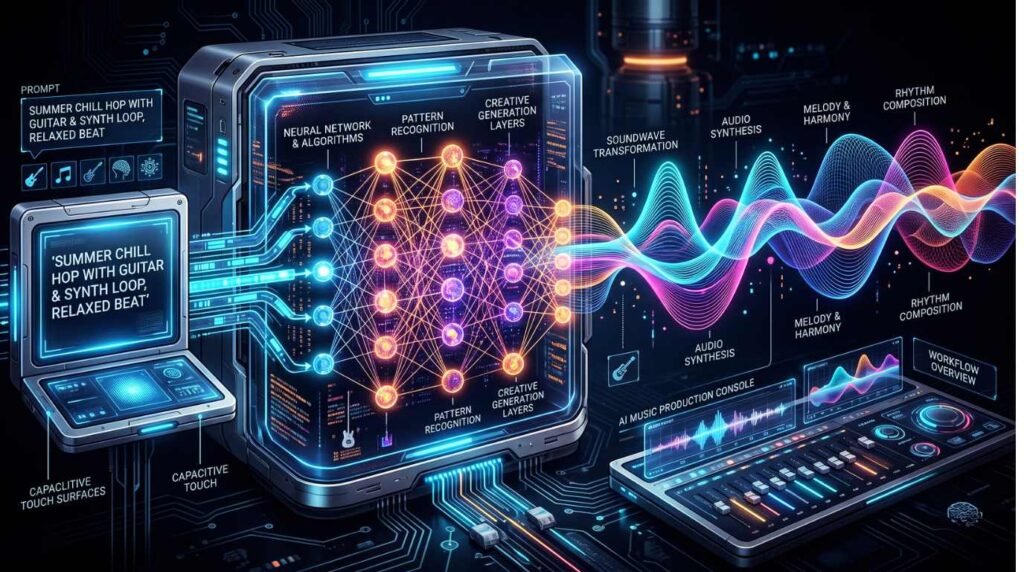
This represents the frontier of modern AI music—software capable of transforming text-based prompt styling, structural parameters, or reference tracks into fully arranged, high-fidelity audio files. Instead of tweaking individual knobs, the creator acts as a creative director or executive producer, shaping the emotional direction, genre boundaries, and overall thematic narrative while the AI model handles the foundational sound synthesis.
A stellar example of this multi-faceted execution can be experienced directly in deep, vocal-driven electronic arrangements like Still Living in You, where intricate melodic pacing and crisp modern production qualities blend seamlessly to form a cohesive, radio-ready audio asset.
How AI Is Changing Music Creation
The integration of artificial intelligence is fundamentally dismantling the traditional barriers of the music industry. It shifts the focus away from technical gatekeeping and returns it squarely to pure creative vision. This revolution is driven by two main pillars:
1. The Total Democratization of Sound
Historically, an artist with a brilliant conceptual theme or a beautiful lyrical story but zero knowledge of music theory or keyboard composition was locked out of the creative process. They had to rely on expensive session musicians or production houses to translate their thoughts into soundwaves.
AI music platforms change this entirely. By speaking the language of emotion, imagery, and style, anyone can now bring an auditory concept to life. It gives independent creators, game developers, and writers the autonomy to score their own universes without needing a massive studio budget.
2. High-Speed Iteration and Overcoming Friction
For traditional producers, spending hours or days programming a synth patch or aligning drum transients can completely drain creative energy. AI compresses this timeline from days into mere seconds.
Need five different stylistic variations of a cinematic ambient loop to see which fits a video scene best? Generative models can deliver those variations instantly. This rapid feedback loop allows creators to test ideas at the speed of thought, leaving them with more mental energy to focus on arrangement, curation, and final polishing.
How AI Music Production Works (The Tech Made Simple)
For many, generative artificial intelligence feels like magic: you type a sentence, press a button, and a fully mixed track emerges. However, beneath the surface lies a sophisticated pipeline of data science, signal processing, and advanced neural architecture. Understanding this process demystifies the tool and helps you write better prompts.
From Audio Data to Neural Networks
Before an AI model can generate a single note, it must go through an intensive training phase. Machine learning algorithms are fed hundreds of thousands of hours of audio files along with rich metadata (text descriptions detailing genre, tempo, instrumentation, key, and emotional mood).
During this training, the neural network analyzes the mathematical relationships within sound waves. It learns how a bass drum interacts with a bassline, what frequencies define a “cinematic strings” section, and how vocal harmonics are structured across different genres.
The Text-to-Audio Translation Mechanism
When you input a text prompt into a generative AI music platform, the system triggers a multi-layered translation process:
- Natural Language Processing (NLP): The AI breaks down your text prompt to understand your creative intent, isolating keywords related to style, instruments, speed, and emotion.
- Latent Space Mapping: The model navigates its “latent space”—a massive digital map of musical characteristics—to find the exact mathematical intersection that matches your keywords.
- Acoustic Generation & Diffusion: Similar to how AI image generators create visuals out of digital noise, audio models utilize diffusion techniques to shape raw audio data into clean, structured waveforms, piece by piece, following strict musical timelines.
Benefits of AI Music Production
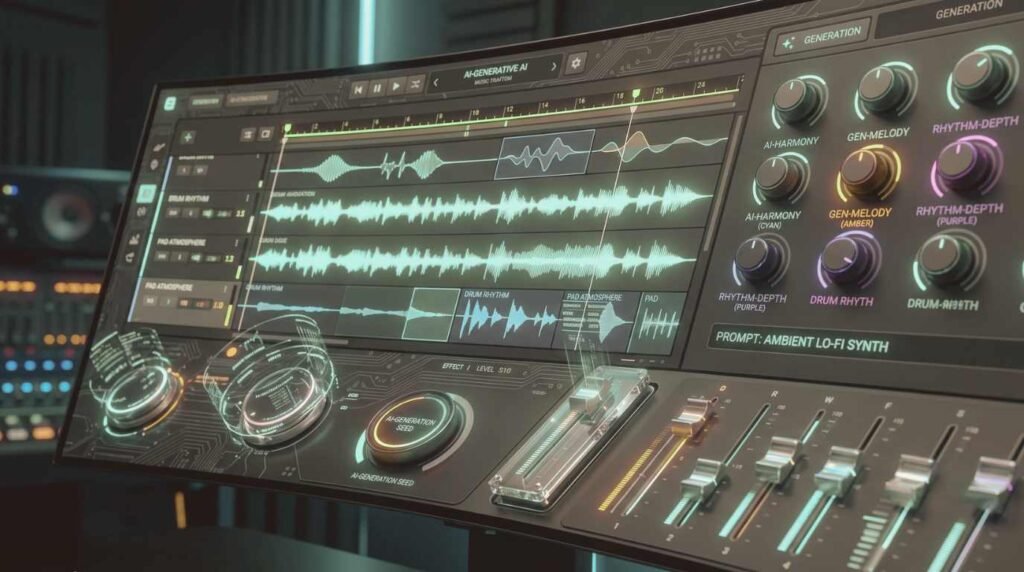
Integrating AI into your creative ecosystem offers transformative advantages that go far beyond just saving time. It fundamentally changes your creative capacity.
1. Crushing Writer’s Block Instantly
Every producer faces the dreaded empty project file. AI acts as an infinite brainstorming partner. By generating a few quick variations of an idea, you gain instant raw material—a unique bass groove, an unexpected chord progression, or a vocal texture—that you can immediately chop up, sample, and build upon.
2. Multi-Genre Flexibility and Experimentation
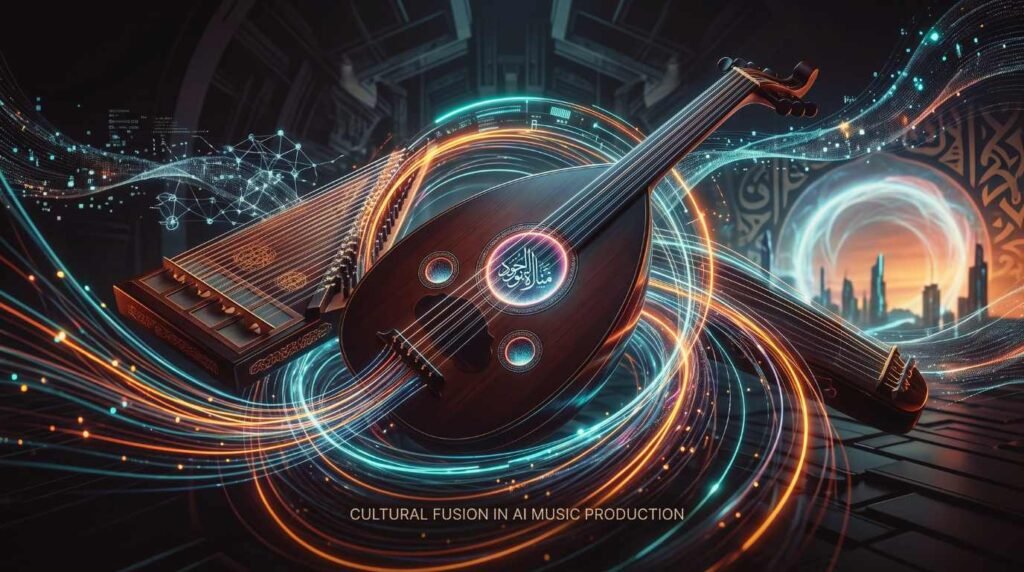
True creative freedom means being able to experiment across cultural and stylistic boundaries without restriction. Advanced AI models excel at blending distinct musical elements that traditional workflows struggle to bridge smoothly.
For example, look at how modern production handles cultural fusion in tracks like مَنَارَةُ الوُجُودْ و نَبْضُ الأَرْضِ. Here, the AI architecture seamlessly processes rich, traditional Arabic vocal scales and instrumentation alongside deep, contemporary soundscapes. It showcases an intricate understanding of non-Western musical structures and emotional pacing that would normally take a cross-continental studio team weeks to coordinate.
3. Hyper-Scale Production for Media and Content Creators
If you are an indie game developer, film editor, or podcaster, you constantly need original, copyright-safe audio that matches specific scene lengths and emotional cues. AI music production allows you to scale your content output effortlessly, generating high-fidelity background scores, transition sound effects, and ambient loops tailored perfectly to your project specs.
Traditional Music Production vs. AI Music Production
To understand where your workflow fits in this modern landscape, it helps to compare the classical approach with the AI-driven paradigm:
| Feature | Traditional Production | AI-Driven Production |
| Skill Curve | Years of learning music theory, synthesis, acoustics, and software interface layouts. | High focus on creative direction, conceptualization, and prompt engineering. |
| Time Investment | Hours to weeks per track (tracking, editing, mixing, mastering). | Seconds to minutes for core generation; hours for curation and polishing. |
| Hardware Requirements | Powerful computers, audio interfaces, studio monitors, acoustic treatment, and instruments. | A web browser, a stable internet connection, and basic monitoring gear. |
| Creative Control | Absolute micro-control over every single note, velocity, and audio frequency. | Macro-control over arrangement, mood, style, and structural boundaries. |
Common Misconceptions About AI Music
As artificial intelligence cements its place in the creative arts, a massive wave of skepticism and misinformation has followed. To truly master AI music production, we must debunk the most common myths circulating in the industry today.
Myth 1: “AI Music Lacks Soul and Emotional Depth”
The most frequent argument against AI audio is that a machine cannot feel, and therefore, its output cannot evoke genuine human emotion. This stems from looking at the technology backward.
AI does not generate music in a vacuum; it responds to human prompts, emotional direction, and intentional curation. When a creator guides the system with sophisticated thematic elements, the results can be profoundly moving. The emotional weight does not originate from the silicon—it originates from the intent of the director guiding it.
Myth 2: “It Is Just Plagiarism and Stitching Audio Samples Together”
Many believe that generative AI models operate like a digital collage engine, cutting up copyright-protected MP3 files and gluing them back together. This is technically incorrect.
AI music models do not store or copy audio clips. Instead, they use mathematical weights and probabilities to generate completely unique, synthetic soundwaves from scratch, based on the abstract concepts they learned during training. Every generated waveform is as mathematically unique as a newly recorded guitar track in a physical studio.
Can AI Replace Human Musicians? (The Collaborative Reality)
The short answer is no. Artificial intelligence is not here to replace musicians; it is here to replace the technical friction that limits them.
Throughout history, every major leap in music technology was met with fear of replacement:
- The invention of the Synthesizer was criticized for “killing physical orchestras.”
- The rise of Samplers and Drum Machines was accused of “destroying the livelihood of live drummers.”
- The introduction of DAWs and Auto-Tune was seen as the “end of real vocal talent.”
In every single case, the technology didn’t eliminate creators—it multiplied them. AI is simply the next iteration of this evolutionary chain.
[Human Creative Vision + Emotional Intent]
                   │
                   ▼
       [AI Generative Synthesis]
                   │
                   ▼
   [High-Fidelity Unified Artform]
The true power of this technology lies in Human-in-the-Loop Collaboration. AI provides raw sonic potential, but the human artist provides the soul, the conceptual storytelling, and the final critical evaluation.
A definitive testament to this collaborative depth can be heard in atmospheric compositions like Human Resonance. The track beautifully illustrates how digital synthesis can mimic and expand upon organic textures, creating a haunting, deeply evocative soundscape that resonates with the core of human experience. It serves as sonic proof that AI, when directed with creative precision, behaves not as a replacement, but as an expansive mirror to our own artistic expressions.
Popular AI Music Tools (An Overview)
To build a streamlined workflow, it helps to understand that the “AI music tool” landscape is not uniform. Different tools serve completely distinct purposes depending on where you are in the creative process. Instead of overwhelming you with reviews, we can categorize modern platforms into three distinct pillars:
1. Generative Text-to-Audio Engines
These platforms generate full-length track arrangements, instrumentation, and vocals based entirely on text descriptions or parameter inputs. They are ideal for quick brainstorming, generating backing tracks, and rapid prototyping of conceptual directions.
2. Intelligent Mixing and Mastering Utilities
These tools are designed to take your raw audio files and finalize them for distribution. Using machine learning models, they analyze the dynamic range, frequency balance, and spatial imaging of your tracks, automatically applying professional adjustments that traditionally required expensive studio hardware.
3. Smart Plugins and DAW Extensions
These utilities live inside traditional recording software. They assist with specific micro-tasks, such as generating MIDI chord progressions, separating individual instruments (stems) from a stereo file, or correcting vocal pitches naturally.
Who Can Benefit From AI Music Production?
AI music creation is a highly versatile medium that extends far beyond traditional recording artists. The democratization of audio synthesis benefits a diverse ecosystem of creators:
- Content Creators & Youtubers: Instantly generate royalty-free, copyright-safe background music that perfectly matches the emotional pacing of video edits without fear of copyright strikes.
- Independent Game Developers: Score entire video game environments, ambient loops, and character themes dynamically on an indie budget.
- Traditional Music Producers: Break through stubborn writer’s block, generate unique vocal chops or textures to sample, and speed up tedious technical mixing phases.
- Filmmakers & Directors: Create temporary soundtrack sketches (temp tracks) or finalize professional cinematic scores that sync directly to visual timestamps.
Traditional Music Production vs. AI Music Production
To see where your creative process fits in this modern landscape, it helps to contrast the classical approach with the AI-driven paradigm across major production bottlenecks:
| Feature | Traditional Production | AI-Driven Production |
| Skill Curve | Years of learning music theory, synthesis, acoustics, and software interfaces. | High focus on creative direction, conceptualization, and prompt engineering. |
| Time Investment | Hours to weeks per track (tracking, editing, mixing, mastering). | Seconds to minutes for core generation; hours for curation and polishing. |
| Hardware Requirements | Powerful computers, audio interfaces, studio monitors, acoustic treatment, and physical instruments. | A web browser, a stable internet connection, and basic monitoring gear. |
| Creative Control | Absolute micro-control over every single note, velocity, and audio frequency. | Macro-control over arrangement, mood, style, and structural boundaries. |
Getting Started: Your First AI Music Workflow
If you are ready to transition from a passive listener to an active creator, your first step does not require an expensive setup. Follow this clean, iterative framework to build your first AI track:
[1. Define Concept] ──> [2. Engineer Prompt] ──> [3. Crate & Select] ──> [4. Polish & Post]
Step 1: Define the Blueprint
Before touching any software, outline your musical goal. Define the genre (e.g., Electronic, Ambient, Cinematic), the target BPM (tempo), the primary instrumentation (e.g., analog synths, acoustic piano), and most importantly, the emotional narrative or mood.
Step 2: Engineer Your Text Prompt
Translate your blueprint into a highly optimized text prompt. Avoid vague phrases like “make a good song.” Instead, use descriptive, modular keywords focusing on textures and style.
Example Prompt Structure: “Deep dark-synthwave track, heavy driving bassline, retro analog synthesizers, cinematic atmosphere, 110 BPM, melancholy yet energetic mood.”
Step 3: Curation and Selection
An AI engine will typically output multiple variations based on your prompt. Your job as the executive producer is to listen critically. Select the generation that captures the best rhythmic groove or structural hook. If a track is almost perfect but lacks depth, use generation settings to iterate on specific sections.
Step 4: Final Polish and Export
Take your chosen generation and prepare it for delivery. Whether you feed it into an AI mastering engine to boost the overall clarity or import it into a DAW to trim sections and add a custom intro, this final layer of human curation is what turns a raw AI output into a finished, professional asset.
Frequently Asked Questions (FAQ)
Is AI-generated music legal to use commercially?
Yes, but it depends entirely on the terms of service of the platform you use. Most professional platforms grant full commercial usage rights if you use their paid or premium tiers. Always review the license structure of your chosen tool before releasing tracks to streaming services.
Do I need musical training to use AI music software?
Not at all. AI tools communicate using human language, emotion, and conceptual ideas rather than complex music notation. However, having a basic understanding of musical terms (like tempo, arrangement, and genres) will significantly improve your ability to write precision prompts.
Can I mix traditional instruments with AI generations?
Absolutely. This is actually the preferred workflow for top-tier modern producers. Many artists use generative tools to create unique background textures, vocal pads, or drum grooves, and then record live guitars, vocals, or bass on top of them to merge organic human performance with synthetic elements.
Conclusion
AI music production is not a trend; it is a permanent shift in the creative landscape. By eliminating the technical friction of sound engineering, it allows your pure artistic vision to take center stage. The tools are ready, the barrier to entry has vanished, and the future of sound is entirely yours to shape.
Explore the possibilities, experiment with different sonic boundaries, and dive deeper into the evolving world of generative art right here at Collective Finity.